Dry Needling in Frankston: What It Is and What It Feels Like
Most people don’t book in for dry needling. They book in for a neck that won’t turn, or a shoulder that’s been aching since Wednesday, and needling comes up halfway through the appointment. That’s usually when the questions start. Is that acupuncture? Does it hurt? And why would you put a needle into a muscle that already hurts?
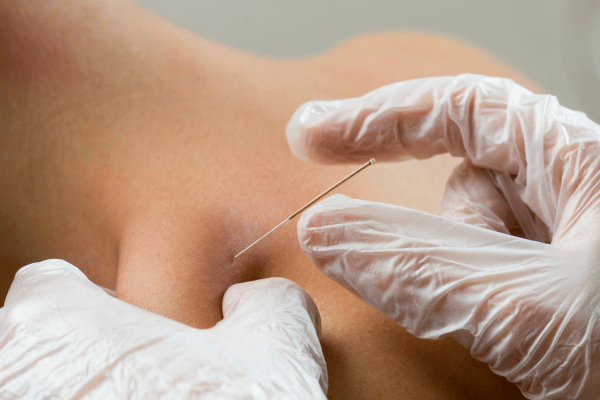
Dry needling is a treatment where a very fine, solid needle is placed into a tight, tender spot in a muscle. It’s used to reduce local pain and sensitivity so you can move more freely and get on with the strengthening work. It is one part of a plan, not the whole plan.
What is a trigger point?
A trigger point is a tender spot inside a tight band of muscle. Press it and you often get a deep ache, and sometimes pain somewhere else entirely. The one we see most often is an upper trapezius, the muscle running from your neck out to the tip of your shoulder, sending an ache up behind the ear and into the temple. People arrive convinced something is wrong with their head. Often enough, it’s the shoulder. Now the honest part. The sore spot is real, and we can find it reliably enough to work with. What is actually happening inside it is still argued about. So it’s more useful to picture a patch of muscle stuck on high alert than a knot you untie.
Does dry needling hurt?
Less than you’re picturing. The needle is solid and filament-thin, far finer than the hollow needle used for a blood test or a flu shot, and it isn’t pushing anything into you. Most people feel a small scratch as it goes through the skin. Plenty feel nothing at all. What you do tend to feel is a deep, dull ache when the needle reaches the spot, and sometimes a quick involuntary twitch in the muscle. It’s an odd sensation the first time. It passes in seconds. Technique ranges from very gentle to firmer, and there is no clinical reason to push you past what you can comfortably tolerate.
What will I feel afterwards?
Worth knowing in advance, so none of it takes you by surprise:
- Local soreness for 24 to 48 hours, a bit like the day after a solid gym session. Common, and expected.
- The occasional small bruise. Also common.
- Some people feel briefly light-headed during or after treatment.
Move normally afterwards. Keep the area warm, drink some water, and leave heavy training for the following day.
How we use dry needling at Peninsula Physio & Rehab
Assessment first, every time. If needling isn’t going to add anything to your treatment, we’ll tell you. Where it is appropriate, it sits inside the same sequence we use for most musculoskeletal problems. Settle the tissue and restore movement with hands-on treatment, then load it back to full capacity with a program you do at home. The needling is the front end. The strengthening is where the lasting change comes from, and we’d rather be straight with you about that than book you in for needling every fortnight indefinitely.
If something has been nagging at you and you’re curious whether needling would help, come and get it assessed properly. We’re on Wells Street in Frankston. You can book online or ring the clinic on 03 7032 4855, and ask whatever you like , nobody at our clinic minds the questions.
Author: Erin Dunstan
Erin is a myotherapist at Peninsula Physio & Rehab in Frankston. She works mostly with neck, back and shoulder pain, persistent headaches and the kind of niggle people have quietly put up with for years.