What is dry needling?
I’m sure you’ve either experienced or seen images of people at an acupuncturist with needles sticking out of them like an echidna – that’s not myofascial dry needling. While we use the same tool, acupuncture and myofascial dry needling (MDN) have very different treatment philosophies. Acupuncture is a key component of traditional Chinese medicine, a holistic practice that uses the pathways of the body called meridians to bring balance to the body’s energy, or Qi, which can affect your physical, spiritual and psychological health. Dry needling aims to “deactivate” trigger points: painful, sensitive muscle tissue that has become taut over time. Some people call them “knots” or “sore spots”. Whatever you call them, trigger points can be the cause of muscle pain, loss of motion and strength, as well as being the root of chronic headaches.
How does it work and what is the process?
During your appointment, your physiotherapist or myotherapist will assess you and see if dry needling is an appropriate treatment to tackle your concerns. They’ll then identify the trigger points that may be contributing to your pain. You may feel a deep ache, or it can “refer” to other areas of the body. A common referral I see is pain around the temple and ear from an upper trapezius (a muscle on the top of your shoulder) trigger point. You can try it yourself: with one arm relaxed take your pointer and middle finger and place them where your neck meets your shoulder and press down firmly! If you feel an ache or even referral pain up to the side of your head – congratulations! You’ve found a trigger point.
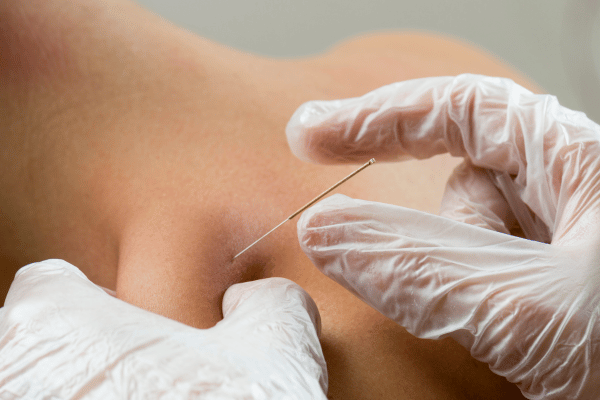
A very fine needle is inserted into the muscle and into the trigger point. The needle stimulates the muscle and allows the contracted tissue to release, returning the muscle back to its normal state. Patients commonly feel a deep ache or will have a twitch response when this happens. Post-treatment you will find the area may be a little sore for a day but then the pain symptoms should subside, and the muscle will not feel so “tight”. Some trigger points can be stubborn, will return and will need a few consecutive treatments to eliminate, creating more long-lasting relief.
It’s a common misconception that because it’s a needle, it must hurt like a flu shot, right? Not necessarily. Needles used for dry needling are 10 times smaller than what they would use to give you an injection. Most people only feel a very light scratch as the needle enters and then an ache comes when the trigger point has been stimulated. In my experience each muscle feels a little different and every person will have a different sensation. There are also techniques ranging from very gentle to a more aggressive approach, where the practitioner will want to elicit as much twitch response from the muscle as they can. We will tailor your treatment to your comfort level and talk you through the whole process to make the whole experience as beneficial as possible.
How does it help with my pain?
Dry needling can help with stubborn aches and pains that like to stick around, even after stretching, massage or exercise. It can also be useful for those people who find deep tissue too intense, as the needle goes straight to the source of the pain.
Like anything, dry needling is not a “quick fix” or magic solution for musculoskeletal pain. Overuse of a muscle, too much time sedentary and certain chronic conditions without intervention will always lead to pain coming back. Dry needling can be a part of that plan, providing initial relief that will give you more capacity to get on the road to recovery.
Of course, with any treatment, there are some risks involved, and some health conditions or medications (such as blood thinners) can pose an increased risk, so talk to your practitioner about any concerns you may have prior to your treatment. If you’re curious about dry needling or you are a dry needling frequent flyer, get in touch with us! We are more than happy to answer any additional questions you may have about dry needling and how we can use it in your next treatment!
Wondering if dry needling suits you?
Dry needling isn’t right for everyone, and the only way to know is a proper assessment. Book online or call us on 03 7032 4855, and one of our myotherapists or physiotherapists will check whether it fits your treatment plan – and talk you through it before a single needle comes out.
By Erin Dunstan
Erin is a myotherapist at Peninsula Physio & Rehab. She specialises in combining manual therapy and exercise to alleviate musculoskeletal pain and maintain movement throughout all stages of life.